Is Claude Tag Secure? Risks, Data Privacy & a Security Checklist
Conclusion First: Claude Tag's security posture is fundamentally determined by administrator configuration. Anthropic provides a robust framework—dedicated Agent Identity, channel-scoped permissions, immutable audit logs, default-deny networking, and strict spend caps. However, the operational risk depends entirely on your adherence to least-privilege principles. Below, we detail the complete enterprise risk matrix, outline pending compliance gaps, and provide a deployable security checklist.
⚠ Transparency Notice: We do not claim Claude Tag is universally "fully secure" or "compliant" for all regulatory environments. During beta, we document verifiable security controls and highlight the specific compliance vectors organizations must validate directly with Anthropic.
Applicable: Claude Team & Enterprise · Status: Beta · Data: Official Docs + Media Verification
Audit Protocol: Score your Claude Tag security posture
**Immediate Action**: Evaluate your organizational rollout against seven critical security controls. This client-side tool calculates your risk posture, identifies critical vulnerabilities, and generates a structured summary for your InfoSec review. (Note: For granular, channel-level validation, utilize the Permission and Ambient tools).
1Are you on agent identity (channels act as service accounts), off the old personal-login app?
2Is each channel scoped least-privilege (internal / client / regulated)?
3Is ambient mode off by default, on only for internal-only channels?
4Is it off for client-facing, regulated, and private channels?
5Are org-wide + per-channel caps with 75% / 95% alerts set?
6Do you review the audit log and who-requested-what on a schedule?
7Have you verified data handling and any required certs (SOC 2 / HIPAA / GDPR) with Anthropic for your obligations?
Architectural Evaluation: Is Claude Tag inherently secure?
The Reality: Claude Tag is not 'secure by default'; it is 'securable by design'. The architecture provides essential enterprise safeguards—isolated agent identity, granular channel-level permissions, default-deny network topologies, comprehensive audit logging, and financial spend caps. However, these tools require active, deliberate configuration. A negligent deployment instantly creates massive data exposure risks.
Core Security Pillars: Three mechanisms govern the security model. 1) Agent Identity: @Claude executes operations via distinct service accounts, preventing credential hijacking and ensuring clear attribution. 2) Per-Channel Scoping: Access is restricted to explicitly authorized channels, rejecting org-wide default grants. 3) Containment Controls: Features like memory deletion, network denial, and spend caps mitigate the blast radius of misconfigurations.
Source Verification: Agent-identity framework verified via Anthropic's official access-model documentation; containment controls corroborated across multiple technical media reports.
The Enterprise Risk Matrix: Vulnerabilities, Mitigations, and Residual Risk
Strategic Planning: A feature list is inadequate for InfoSec. You require a comprehensive risk matrix detailing specific threat vectors, Anthropic's built-in mitigations, the critical residual risks your team must manage, and the verification status of each claim.
| Risk Vector | Threat Description | Anthropic Mitigation | Residual Enterprise Risk | Required Admin Action | Verification |
|---|---|---|---|---|---|
| Data Exposure | Claude ingests channel context and connected API data. | Per-channel access bundles; strict isolation of private channels. | Misconfigured channels expose sensitive data cross-functionally. | Enforce strict channel scoping; limit tool integrations. | media |
| Agent Identity Spooking | Inability to attribute AI actions versus human actions. | Dedicated service accounts; cryptographic attribution to requester. | Access remains channel-bound, not user-bound. | Govern access at the channel level. | official |
| Privilege Escalation | Standing API access outliving specific tasks. | Admin-only configuration; least-privilege tiered bundles. | Stale 'Day 1' permissions become security liabilities. | Implement periodic access reviews and revoke unused integrations. | media |
| Autonomous Ambient Action | Claude executes actions unprompted. | Disabled by default; requires explicit per-channel activation. | Complex attribution in regulated environments. | Strictly prohibit Ambient Mode in client/regulated channels. | official |
| Cross-channel bleed | One client's context surfacing elsewhere | Learning is per-channel opt-in; private isolated | Agent judges "relevance" in multi-tenant | Learning off for client/regulated/private | media |
| Runaway spend | Consumption billing; ambient burns tokens | Org + per-channel caps; 75%/95% alerts; over-limit task declined | Caps mis-set halt or miss | Set caps as blast-radius limits | media |
| Tool abuse / exfiltration | Calling systems you didn't approve | Agent Proxy default-deny; raw keys never reach model/sandbox | Allowlist only as good as your config | Maintain it; review network audit | media |
| Auditability | Can you trace what happened | Org > Claude Tag > Audit: task + requester + network calls; PR links to thread | Cross-channel ambient audit still maturing | Review on a cadence | media |
| Data retention | What's kept after disconnect | Admin view/edit/delete memory; deleted within 30 days on disconnect | Slack messages follow *your* retention | Set it; delete on offboarding | media |
| Vendor / compliance | SOC 2 / HIPAA / GDPR / residency / training | Marketplace shows a compliance section | **Unconfirmed**; Slack won't sign BAAs for 3rd-party apps | Verify with Anthropic | unknown |
Data Privacy Architecture: Context Ingestion and Model Training
Data Boundary Definition: The three critical privacy vectors are data visibility, retention, and model training. Claude Tag processes explicitly authorized channel context and connected tool data. It structurally cannot report from unauthorized private channels. Memory stores are fully admin-controlled and auto-purged within 30 days of agent disconnection.
Memory Management: Claude maintains workspace and channel-specific memory to optimize context retrieval. Public channel memory is shared; private channel memory remains strictly isolated. Upon uninstallation, Anthropic purges this memory within 30 days. Note: Your native Slack message retention policies continue to govern the underlying text.
Model Training Policy: Whether Anthropic utilizes your enterprise data to train foundation models is dictated entirely by your specific commercial agreement (e.g., Enterprise tier vs. standard terms). Do not rely on general blog posts; verify the training exclusion clause in your contract before connecting proprietary data.
Identity & Accountability: Cryptographic Attribution
Service Account Model: Claude Tag strictly rejects 'user impersonation'. Within a channel, it executes exclusively under its own provisioned service accounts (e.g., the Claude GitHub App). Every executed action is cryptographically bound to both the AI agent and the human user who triggered the request.
Audit Integrity: An AI operating via a borrowed human login destroys audit trails. By enforcing distinct Agent Identity, enterprise logging tools can differentiate machine action from human action. A GitHub PR authored by Claude will explicitly flag the Claude service account and link back to the originating Slack thread.
Least-Privilege Enforcement: Channel-Level Scoping
Access Governance: Permissions are governed strictly at the channel level by Slack Owners. The critical paradigm shift: Access is channel-bound, not user-bound. If a user possesses read/write access to a channel, they inherit the ability to utilize any API tool connected to that specific channel.
Deployment Strategy: Secure the channel, not the individual. Provision tool integrations using the principle of least privilege. Segregate sensitive write-access APIs (e.g., production databases) into restricted, locked-down channels. Expanding access is trivial; retracting compromised data is impossible. This is your primary defense vector.
Autonomous Operations: Ambient Mode Risks
Proactive Exposure: Ambient Mode enables @Claude to execute actions and surface cross-channel context without explicit @mention triggers. This fundamentally alters the risk profile. Because it operates autonomously, it is disabled by default. Administrators must never enable Ambient Mode in client-facing or strictly regulated channels.
Risk vs. Reward: Enabling Ambient Mode exponentially increases data exposure risks because the agent exercises independent judgment regarding what context is 'relevant'. Attribution becomes complex. Anthropic officially recommends delaying Ambient Mode deployment until the organization has established baseline behavioral patterns in reactive mode.
Containment Controls: Audit Logs and Network Isolation
Blast Radius Mitigation: Enterprise security assumes misconfigurations will occur. Claude Tag mitigates these via three containment layers: 1) Immutable Audit Logs, 2) Default-Deny Agent Proxy Networking, and 3) Hard Spend Caps. These ensure that when a channel is over-permissioned, the damage is observable, restricted, and financially capped.
Technical Implementation: Within `Org settings > Claude Tag > Audit`, administrators review every executed task, the invoking user, and specific API calls. The Agent Proxy architecture ensures outbound network requests to non-allowlisted domains are hard-blocked; the LLM never accesses raw API keys. Furthermore, consumption-based spend caps (with 75%/95% alerts) will outright decline tasks that exceed organizational limits.
Compliance Ledger: Unverified Claims & Open Questions
Regulatory Due Diligence: We reject superficial security marketing. During beta, specific regulatory compliance certifications remain unverified by third-party auditors. If your organization operates under strict compliance regimes (SOC 2, HIPAA, GDPR), you must directly validate the following items with your Anthropic account executive.
| Open question | Where it stands | Our label → how to close it |
|---|---|---|
| SOC 2 / ISO 27001 certified? | Only general AI-security vendors advertise this; no Claude Tag-specific confirmation found | Unknown→ ask Anthropic for the current report |
| HIPAA-eligible? | Slack's Marketplace listing shows a compliance section, but Slack does not sign BAAs for third-party apps, and prior reports conflict | Unknown→ needs a Marketplace screenshot + your own BAA path before any PHI |
| GDPR / data residency? | The announcement and Help Center don't spell out Tag-specific terms | Unknown→ verify in your commercial agreement |
| Does Anthropic train on our content? | Governed by your commercial + privacy terms; no Tag-specific public statement | Verify→ confirm in your terms; don't assume |
| Pen-test / bug-bounty results? | No public Claude Tag-specific results | Unknown→ request under NDA if your review needs it |
| Per-user (not channel-level) permissions? | Anthropic has signaled identity-aware controls | Planned, not current→ don't design around it yet |
| Required Slack plan tier? | Third-party coverage says "a paid Slack plan"; tier not officially stated | Unknown→ confirm with Slack / Anthropic |
If your rollout touches regulated data, treat every "Unknown" above as a blocker until you've closed it in writing with Anthropic — not with a third-party article, and not with this page.
Pre-Deployment Protocol: Security Configuration Checklist
**Mandatory Operations**: Execute this checklist sequentially before authorizing @Claude in any production channel. This protocol aligns directly with the scoring criteria above. Ensure a human administrator oversees all irreversible infrastructure actions.
- Move to agent identity— off the old personal-login app (it retires Aug 3).→
- Scope every channelinternal / client / regulated, least-privilege.→
- Keep ambient offexcept internal-only channels you trust.→
- Turn cross-channel learning offfor client, regulated, and private channels.
- Set spend capsorg-wide and per-channel, with 75% / 95% alerts.→
- Schedule an audit review— who triggered what, network calls, weekly at first.
- Verify compliance(SOC 2 / HIPAA / GDPR / training) with Anthropic for your obligations.
- Require human reviewfor irreversible actions — deploys, customer messages, data changes.
Run the scorecard to turn this into a posture score and a summary you can take to your security review.
Start the 4-step setup the safe way →Claude Tag security FAQ
Is Claude Tag secure?
It's as secure as you scope it. Anthropic provides agent identity, per-channel permissions, audit logs, default-deny networking, and spend caps; the risk that matters most is how you configure each channel. We don't claim it's "fully secure."
Can Claude Tag read our private channels?
Only if an admin adds it. It doesn't report from private channels, and private-channel memory stays isolated from other channels.
Can it read our DMs?
A DM to Claude runs under your personal claude.ai account, not the org agent. In channels it uses the organization's service accounts.
Does Anthropic train on our data?
That's governed by your commercial agreement and privacy terms — we don't assume it, and you shouldn't either. Verify what applies to Claude Tag in your specific terms before connecting sensitive data.
Is Claude Tag SOC 2 or ISO 27001 certified?
We can't confirm a Claude Tag-specific certification. Ask Anthropic for the current report; don't treat a third-party claim as proof.
Is Claude Tag HIPAA compliant?
Unconfirmed. Slack's Marketplace listing shows a compliance section, but Slack doesn't sign BAAs for third-party apps — verify directly with Anthropic before any PHI use.
What are the biggest security risks?
Mis-scoped channels, ambient autonomy in shared or regulated channels, cross-channel context-bleed, runaway spend, and unverified compliance. See the risk matrix above.
Can we audit what Claude did?
Yes. Org settings > Claude Tag > Audit logs every task, the user who requested it, and network calls made with Claude's credentials; a GitHub PR links back to its Slack thread.
Can it reach systems we didn't approve?
No — Agent Proxy is default-deny. Outbound traffic to non-allowlisted hosts is blocked, and raw credentials never reach the model or sandbox.
What happens to its memory if we disconnect?
Admins can view, edit, and delete channel and workspace memory anytime; on disconnect it's deleted from Claude's systems within 30 days. Slack messages follow your own retention.
How do we make a rollout safe?
Stay least-privilege per channel, keep ambient off except internal-only, set spend caps, review the audit log, and verify compliance. Use the scorecard and checklist on this page.
Is this page official?
No — an independent guide that cites sources and flags what it can't confirm. Always verify in your Anthropic/Claude admin console.
Make your security checklist a living tracker
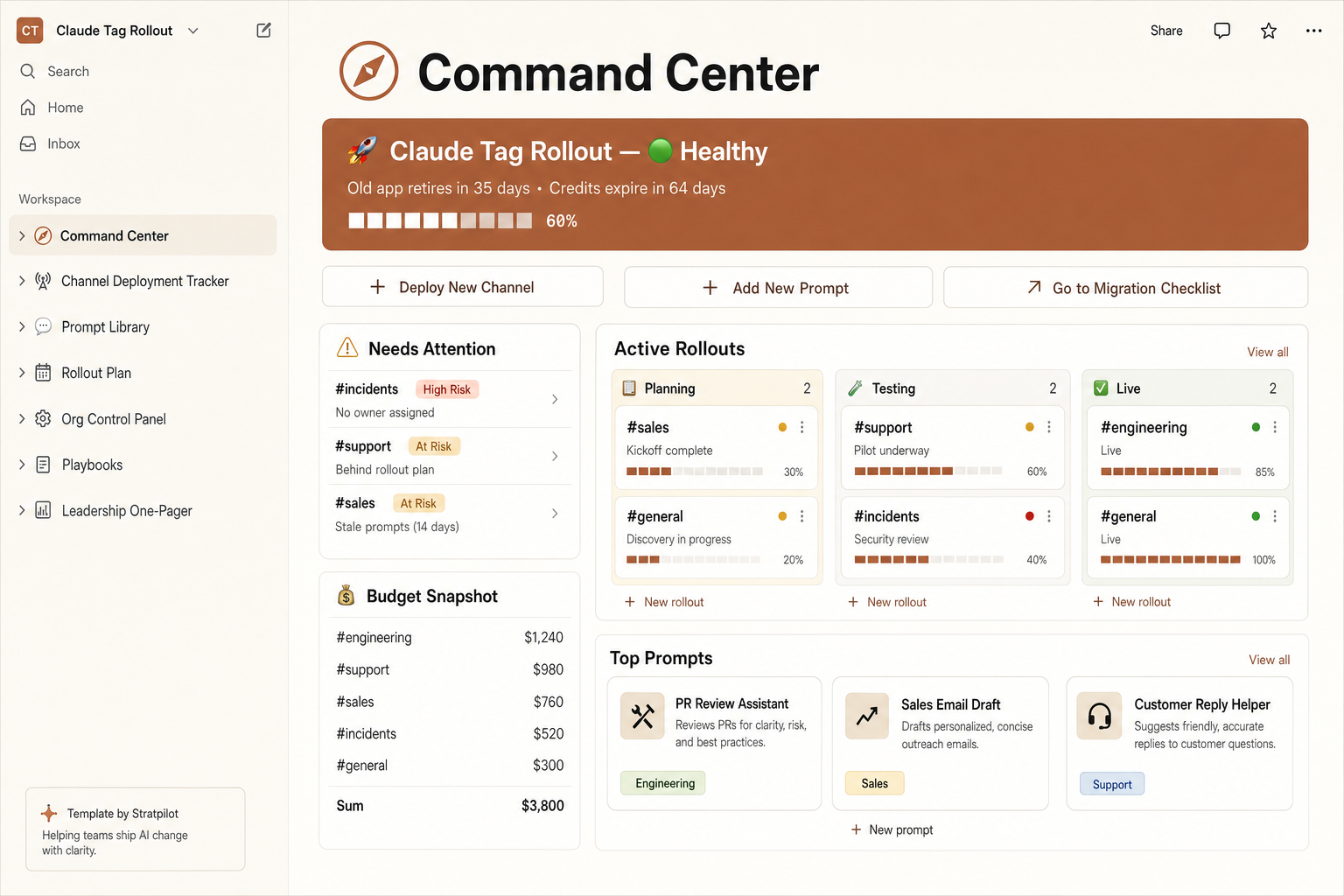
A scorecard tells you where you stand once. The Rollout Command Center keeps every channel's risk rating, audit notes, and access scope in one place your whole team can see — and flags the channels that need attention.
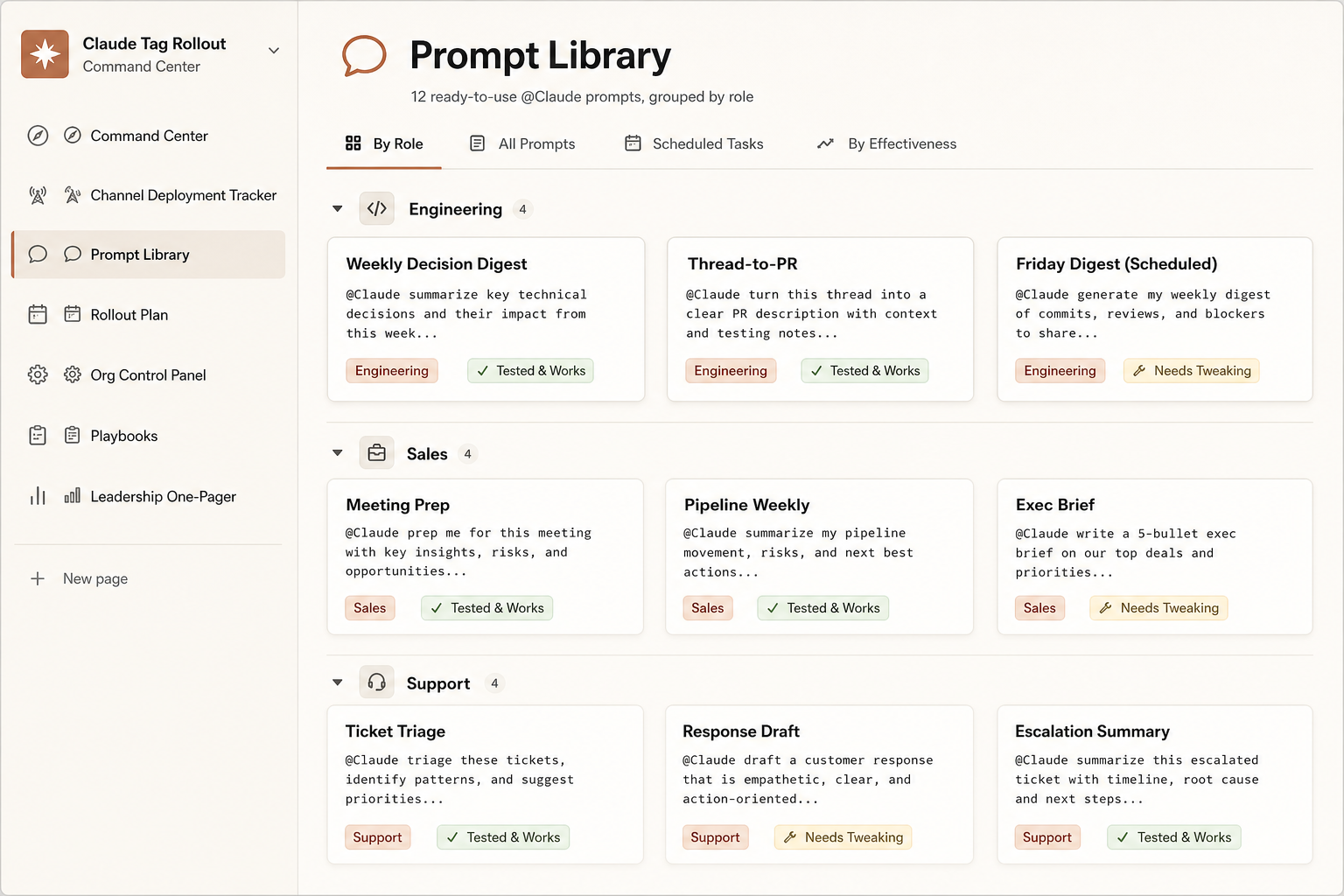
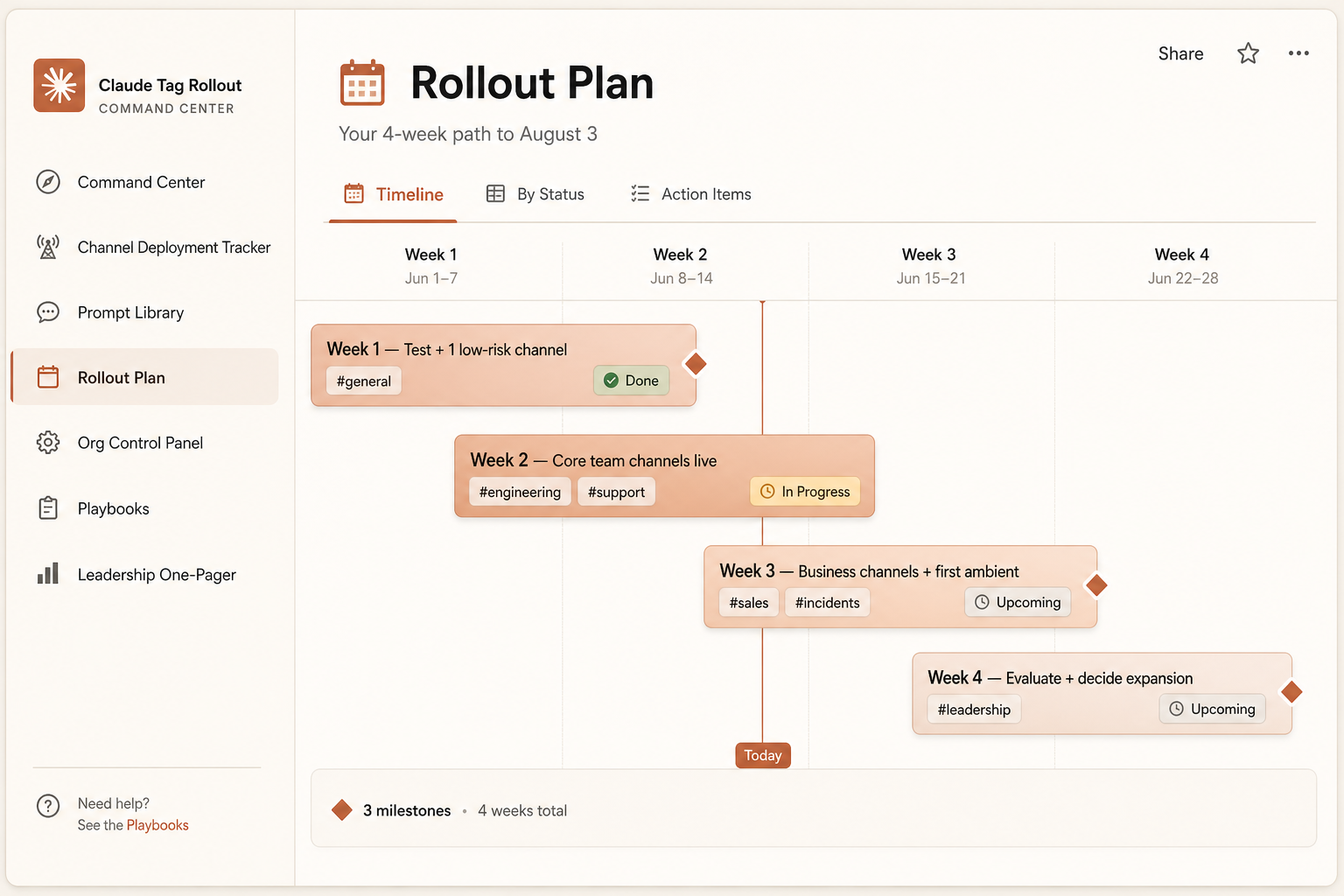
Pre-filled and ready the second you duplicate it: a channel tracker with risk flags, a live credit runway, a 4-week plan, 12 ready prompts, and a boss-ready one-pager.
- Per-channel risk rating + flags
- Access scope & audit notes
- Live credits burn bar + runway
- 4-week rollout timeline
One-time $7 · pre-filled · 14-day refund. Independent template, not affiliated with Anthropic.
Get the security review pack + beta change alerts
We'll email you a one-page security review pack (risk matrix, redline defaults, and the open-questions checklist to take to Anthropic) plus a heads-up when Claude Tag's security, data, or compliance behavior changes during the beta. No spam, unsubscribe anytime.
Sources & how we keep this accurate
The agent-identity model is from Anthropic's announcement and access-model blog. The surrounding controls — audit, default-deny networking, memory retention, spend behavior, ambient default-off — are from those sources plus hands-on coverage and may change during the beta. Risk levels are our guidance, not a compliance guarantee, and compliance items are flagged Unknown because we can't verify them for you.
Last verified June 26, 2026.
- AAnthropic — Introducing Claude Tag & Agent identityofficial
- CClaude Help Center — Claude Tag overviewofficial
- SSlack Marketplace — Claude app compliance sectionmedia
- DDataCamp, Tygart Media, AgentConn, VentureBeat, Unosecurmedia
We are not affiliated with Anthropic or Slack. We do not assert SOC 2, HIPAA, or GDPR status for Claude Tag — verify those directly. Always confirm current behavior in your Claude admin console, and keep a human in the loop for irreversible actions.