Enterprise Migration Guide: Claude in Slack to Claude Tag
**Critical Deadline**: The legacy 'Claude in Slack' integration will be permanently deprecated on August 3, 2026. Anthropic is replacing it with Claude Tag—a fundamentally new, identity-aware agent architecture designed for enterprise environments. This guide provides a verified migration protocol, detailing data retention policies, configuration translations, and the exact steps required to transition without workflow disruption.
Target Audience: Slack Owners / IT Admins (Claude Team & Enterprise tiers) · Estimated Planning Time: 15 minutes
Legacy App Deprecation (Hard Stop)
August 3, 2026
Migration Credit Expiration
September 1, 2026
Dates verified via Anthropic official communications. Consult your admin console for localized enforcement schedules.
Configure Your Custom Migration Protocol
**Dynamic Assessment**: Generic guides are insufficient for enterprise migrations. Input your organizational parameters below (billing tier, seat count, current usage). This tool will compile a deterministic migration checklist, verify your eligibility for transition credits, and sequence the technical deployment steps. Processing is strictly client-side.
1. Plan
2. Seats
3. Using the old Claude in Slack app today?
4. Team type
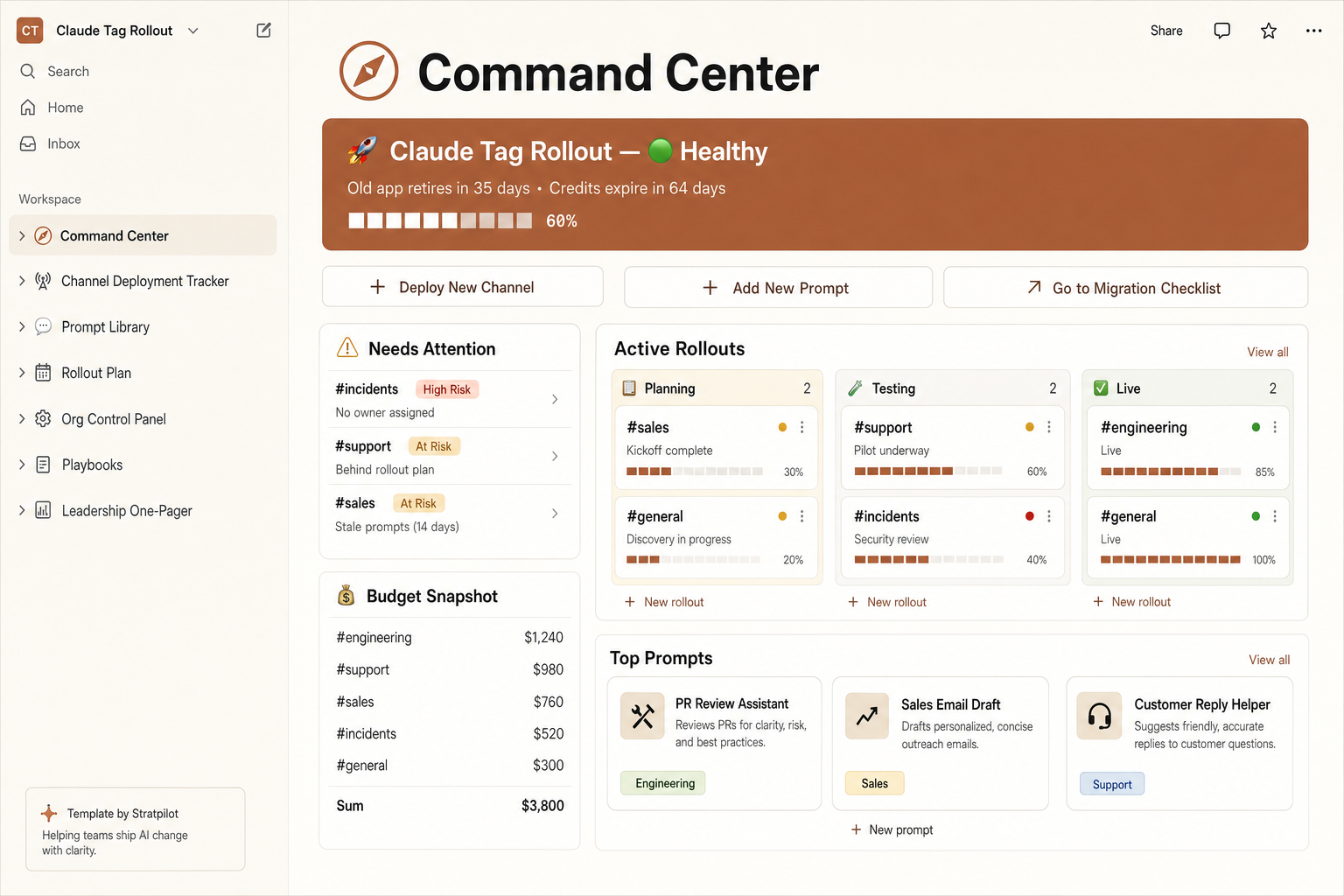
Turn this checklist into a living command center
You just built a one-time checklist. The Rollout Command Center turns it into a living Notion board your team runs the whole migration from — every channel tracked, every credit watched, right up to August 3.
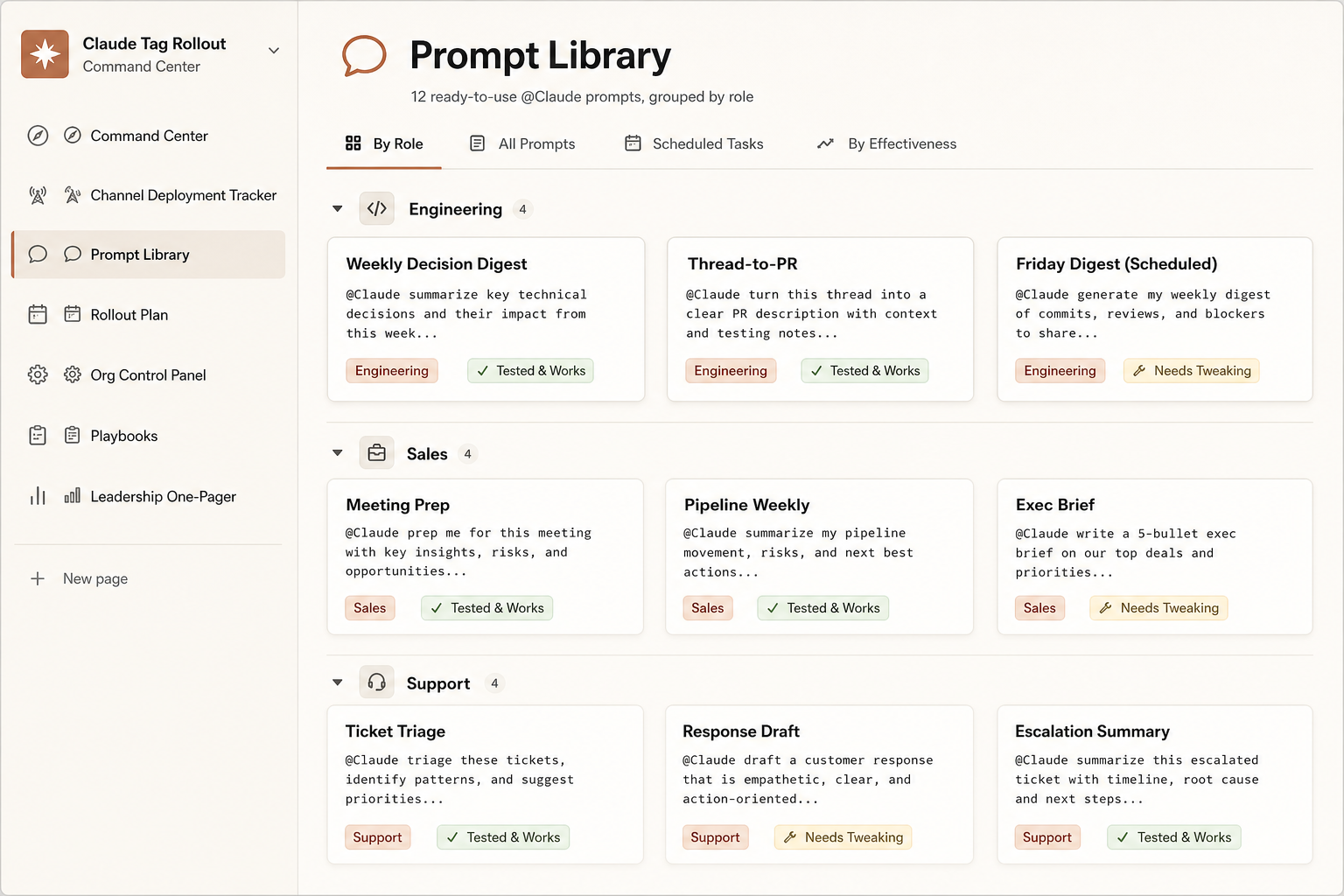
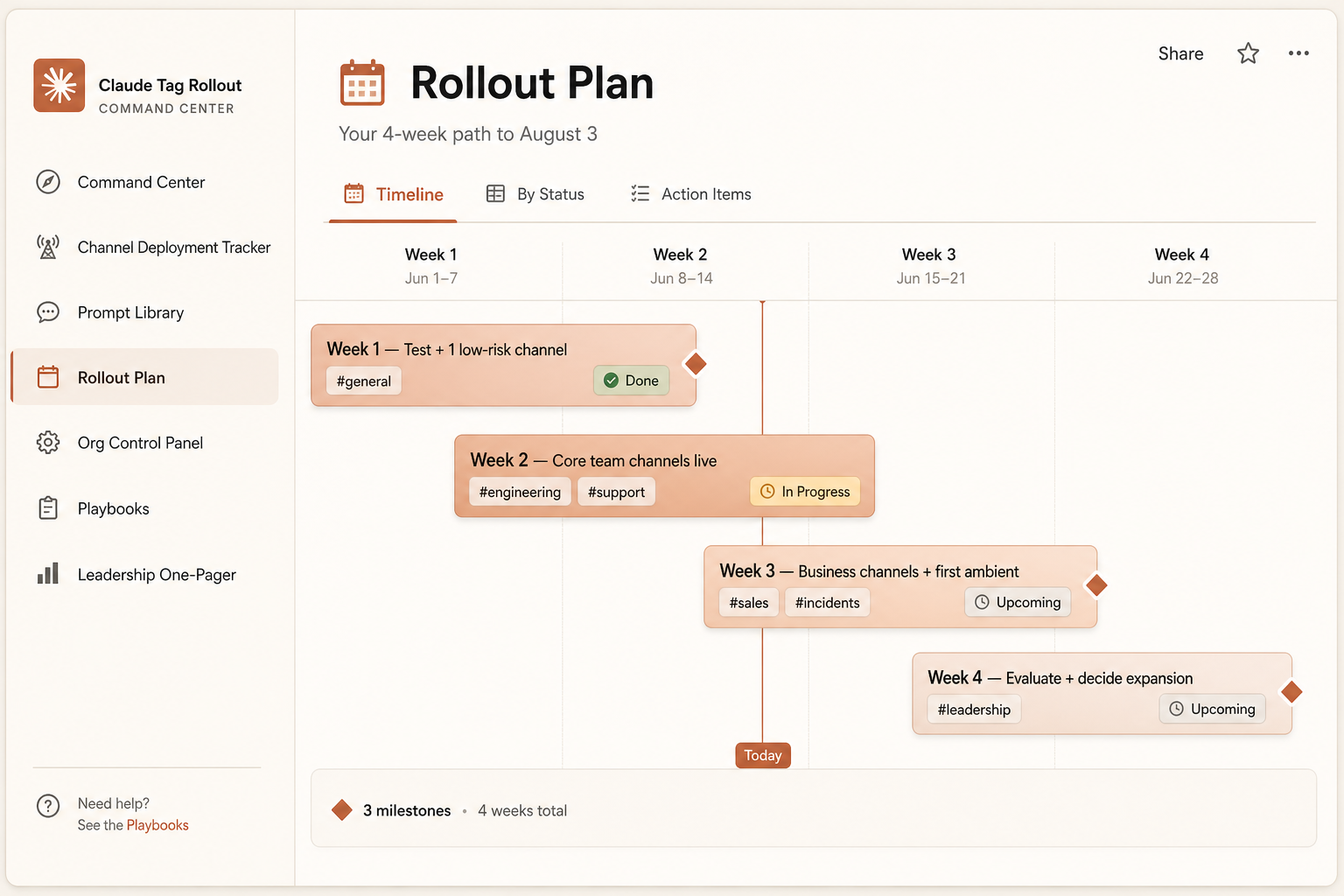
Pre-filled and ready the second you duplicate it: a channel tracker with risk flags, a live credit runway, a 4-week plan, 12 ready prompts, and a boss-ready one-pager.
- Channel tracker with auto risk flags
- Live credits burn bar + runway
- 4-week rollout timeline
- 12 ready-to-use @Claude prompts
One-time $7 · pre-filled · 14-day refund. Independent template, not affiliated with Anthropic.
Deprecation Impact: The Risks of Auto-Migration
**Forced Architecture Shift**: On August 3, 2026, Anthropic will forcefully deprecate the legacy 'Claude in Slack' integration. Workspaces that have not manually migrated will be automatically upgraded to the Claude Tag architecture. This is a critical security event because the new model is fundamentally different.
Auto-migration deploys a shared, agentic AI into your workspace without prior administrative scoping.
The legacy application provided isolated, stateless, user-bound AI instances. Claude Tag deploys a unified, persistent agent operating under an Organization Identity. It possesses cross-channel memory and can interact with enterprise API tools.
Allowing auto-migration means inheriting a powerful autonomous agent with default, unconfigured permissions. Administrators must proactively migrate to manually define channel access, tool boundaries, and disable Ambient Mode before the deadline.
Auto-Migration Security Vulnerabilities:
- Unrestricted channel visibility by default.
- Unscoped API tool interactions.
- Ambient Mode potentially enabled without oversight.
These vectors must be explicitly governed by InfoSec, not defaulted by a deprecation script.
Migration Logistics: Data Retention and Configuration Drift
**Configuration Drift Warning**: The migration is not a seamless 1:1 transfer. While the core Slack workspace pairing persists, all enterprise tool integrations, billing hierarchies, and legacy conversational data do not transfer. Administrators must manually reconstruct the integration environment.
Persistent Infrastructure
- Slack workspace pairing
- Core Claude tier subscription access
Mandatory Reconfiguration
- API Connectors (GitHub, SQL, CRM) — Must be re-authenticated via Agent Identity service accounts.
- Channel Governance — Administrators must manually re-authorize @Claude in specific channels.
- Financial Controls — Must establish new organizational token spend limits.
- Legacy DM History & System Prompts — High risk of deletion; manual export required.Unknown
- Billing Architecture — Transitions from per-user allocation to centralized organizational billing.
Anthropic has not guaranteed the preservation of legacy DM history. Assume total data loss of old conversational context unless manually exported.Media
See the old app vs Claude Tag, side by side →Deployment Protocol: 4-Step Migration Sequence
**Execution Blueprint**: The migration must be executed by a designated Slack Owner via the Claude Organization Console. The sequence requires establishing the secure connection, re-authenticating APIs via service accounts, enforcing financial caps, and validating in a sandbox.
1. Re-Establish Workspace Pairing
Invoke `@Claude connect` within any authorized Slack channel. The agent will return a cryptographic pairing token (valid for 15 minutes). Input this token into the Claude Organization Console to bind the environments.
2. Provision Agent Identity Tooling
This is the most critical phase. Reconnect GitHub, Google Drive, and database APIs exclusively using dedicated Agent Identity service accounts—never personal admin credentials. Scope these integrations strictly to the channels that require them.
3. Enforce Financial Guardrails
Because Claude Tag shifts to a centralized, consumption-based billing model, administrators must immediately configure monthly organizational spend limits to prevent runaway API costs.
4. Execute Sandbox Validation
Deploy @Claude to a single, low-risk private channel. Ensure Ambient Mode is explicitly disabled. Execute simulated workflows to validate API connections and permission boundaries prior to the August 3 deadline.
Community / verify
Heads-up: third-party testers report you need a Slack Owner or Primary Owner — not just an Admin — to run this. Confirm against Anthropic's Help docs.
Will you lose your launch credits if you wait?
Possibly — they're time-boxed. Anthropic is handing eligible Team and Enterprise organizations introductory launch credits to try Claude Tag, but they expire September 1, 2026. To benefit, you generally need 10+ seats and you have to migrate before that date. Credits apply to Claude Tag usage in Slack, not personal DMs.
| Plan | Launch credits | Eligibility | Expires |
|---|---|---|---|
| Enterprise | $25,000 | 10+ seats | Sep 1, 2026 |
| Team | $2,500 | 10+ seats | Sep 1, 2026 |
MediaAmounts and eligibility are from press coverage (last verified Jun 25, 2026). Confirm what your org qualifies for in your Claude admin console.
Estimate your cost and how long credits will last →What actually changes after the migration?
Three things change the day you move to Claude Tag: identity, billing, and visibility. Claude stops acting as you and starts acting as the organization, usage bills to the org instead of individuals, and its work happens in the open channel where the whole team can see and continue it.
Identity
Before: Acts as you — your login and permissions.
After: Acts under the organization identity, with its own connected accounts.
Billing
Before: Cost counts against you, the individual.
After: Usage is billed to the organization.
Visibility
Before: A private, stateless DM.
After: Works in the open channel — the whole team can see and continue.
With the old Claude in Slack app, when you tagged Claude it borrowed your permissions and the cost counted against you. After migration, in a channel, Claude acts under an organization identity with its own connected accounts — it posts as the Claude app in Slack and opens pull requests as the Claude GitHub App. Usage is billed to the organization.
The upside is continuity: a task no longer breaks when the person who started it logs off, because context and access live with the channel, not one employee. The trade-off is that an admin has to configure each channel deliberately. (Personal DMs with Claude can still behave under your own identity.)
A task no longer breaks when the person who started it logs off — context and access live with the channel, not one employee. The trade-off: an admin configures each channel deliberately.
Migrating an agency or multi-client Slack workspace
If one Slack workspace holds more than one client's data, slow down. A shared, always-on agent that can learn across channels is useful internally but risky across tenants. Before you finish the Claude in Slack migration, isolate each client and keep proactive behavior off by default.
Map every channel to one client
A channel with Client A's data should never feed learning that Client B's work could draw on.
Keep ambient mode OFF on client-facing channels
Proactive surfacing is great internally and dangerous across tenants. Turn it on only where the data is all yours.
Decide cross-channel learning per channel
Scope what the agent identity can reach in each channel — not globally.
Not ready before August 3? Here are your options
You don't have to roll Claude Tag out everywhere by August 3 — you just need to be in control of the auto-migration. The safest move is a minimal migration: pair, scope one or two channels tightly, set a spend limit, and leave the rest off until you're ready.
Do the minimum that keeps you in control. Run the four steps in a single private channel, connect nothing you don't need yet, and keep ambient mode off. That way, when August 3 arrives, your workspace is already on Claude Tag on your terms — not auto-configured by default. There's no long-term rollback to the old app once it's retired, so a small, deliberate migration beats letting the deadline decide for you. Expand channel by channel afterward, once you've seen how it behaves with your data.
The minimal viable migration
- 1Pair Claude with Slack
- 2Scope just one or two channels tightly
- 3Set an organization spend limit
- 4Leave every other channel off — keep ambient mode off
No long-term rollback once the old app retires — a small, deliberate migration beats letting the deadline decide. Expand channel by channel afterward.
Claude in Slack migration FAQ
1. When does the Claude in Slack app stop working?
The old Claude in Slack app retires on August 3, 2026. After that date its behavior is gone, whether or not you've migrated — so plan to be running on Claude Tag before then.
2. What happens if I do nothing before August 3?
Anthropic will automatically migrate your workspace to Claude Tag on August 3. You won't lose access to Claude, but you'll inherit an unconfigured shared agent. It's safer to migrate early and scope its access yourself.
3. Will I lose my channels, tools, or DM history?
Your Slack workspace pairing carries over. Tool connectors must be reconnected as service accounts, and your old DM history and standing instructions aren't confirmed to migrate — export them before you start the migration.
4. How do I migrate from Claude in Slack to Claude Tag?
Run @Claude connect in Slack, paste the 15-minute code into your Claude org, reconnect your tools per channel, set an organization spend limit, and test in a private channel before August 3.
5. Do I need to be a Slack Owner to migrate?
Third-party testers report you need a Slack Owner or Primary Owner, not just an Admin, to run the migration. Confirm against Anthropic's official Help docs before you plan it.
6. Will I lose my launch credits if I wait?
Launch credits expire September 1, 2026. Eligible Team and Enterprise orgs with 10+ seats need to migrate before then to use them. Credits apply to Claude Tag usage in Slack, not personal DMs.
7. How long does the migration take?
The four steps take about 15 minutes to plan and run in a test channel. The longer part is deciding which channels and tools to connect — do that deliberately rather than wiring up everything at once.
8. Is the Claude in Slack migration optional?
Not in the long run. The old app is retired on August 3, so every team using it moves to Claude Tag. The only choice is whether you migrate on your own terms or let the auto-migration decide for you.
9. I run an agency — what should I do differently?
Map each client to its own channels, keep ambient mode off on client-facing channels, and decide cross-channel learning per channel so one client's data never feeds another's.
10. Can I roll back to the old Claude in Slack app?
No. Once the old app is retired on August 3, there's no long-term rollback. That's why a small, deliberate migration into a test channel now is safer than waiting.
Don't miss the two deadlines
We'll email you once before August 3 (old app retires) and once before September 1 (credits expire). That's it.
Sources & how we keep this accurate
This Claude in Slack migration guide is maintained independently and updated as Anthropic ships changes. Dates, credits, and steps are sourced below; where details are unconfirmed, we say so. Last verified June 25, 2026.
We are not affiliated with Anthropic or Slack. Always confirm dates and credits in your Claude admin console.